Showing posts with label Malayalam. Show all posts

Monday, July 18, 2011

All about Belly, All about Magic

Ever since its release, Delhi Belly was being flaunted as bold, and a "ground-breaking and inventive" comedy (see Taran Adarsh's review). Nikhat Kazmi (Times of India) said that "it re-writes all the moth-balled rules of an ageing industry".

I waited for the film eagerly, and finally when I saw the film, it was not a complete disappointment. But is it really a path-breaking film? I had enjoyed Mithya (2008) and Sankat City (2009) (two other recent Indian comedies with mix-ups involving under-world / gangsters in the backdrop) as much if not more. (Delhi Belly poster had high resemblance of Hangover -- I guess it was intentional.)


In contrast, Salt n' Pepper was yummy overall (concept, execution both), living up to the accolades it received. One could smell the freshness. It hardly had any 'story' but it held the viewer's interest almost throughout the film. I'd have rated it a great film if it avoided:

1. The repeated laments about a woman's life being incomplete without a man,

2. The scene where the husband lifts the burqa and says "shubanallah" (I found the first burqa scene funny), and

3. The song scene in the second half -- it was plain boring to me.

I'd still rate it the best Malayalam film to have come out this year. Above Adaminte Makan Abu and Traffic.

(My friend Rajeev later told me the first Burkha sequence in this film was 'inspired' from Marai Porul, a Tamil short film by Pon. Sudha.)

Cheers to Aashiq Abu. Cheers to the writers, Syam Pushkaran and Dileesh Nair. Cheers to Lal, Shwetha, Baburaj, Asif Ali and Mythili. Many cheers to the producers and the audience.

[PS: I believe in Magic. I believe in the Deathly Hallows. I believe in J. K. Rowling.]

Sunday, January 30, 2011

Women Start Cheating in Kerala

"..It must have been in the beginning of twenty first century that women started cheating on their husbands in Kerala. There are references to such relationships in Malayalam films that came out circa 2010. While Cocktail (2010) had cheating as its central theme, Traffic (2011) has a cheating wife and a betrayed husband playing important roles. Another 2010 film Pranchiyettan and The Saint has a casual mention of Khushboo's character cheating on her husband.."


Cannot rule this out if one were to write history based on mainstream Malayalam films. With all the problems that I have with these three films, I think one must thank them for that one character that was almost non-existent till now in Malayalam films -- the cheating wife. We have had cheating husbands, though we could not imagine justice playing out in the form of having them paralyzed or the wife running them over with a car.

(Thanks to Devadas, Prasanth et al for the discussions on Google Buzz).

Thursday, August 12, 2010

The Art of Copying, Sathyan Anthikkad and Values

Let me clarify first -- this not a post that make fun of copying.  Let us consider films for instance. I don't think a film is bad because it is a copy. I believe copying is an art and also a political act. It is also known in other names -- inspiration, adaptation. With due credits, or without giving any credits to the "original". (Whether the word "original" makes any sense or not is a different question. Every writer/film-maker gets an idea from somewhere. It could be some real-life events, a story they heard somewhere, or many such stories. Let us leave that part for now.)

So why is it that I don't consider copying a crime? If one knows the job reasonably well (and does it reasonably well), the viewers stand to gain. There is absolutely no point comparing that work with the original.

Take, for instance, some of Priyadarshan's early films in Malayalam. Most of the Malayali filmgoers that time did not have the remotest chance of watching One flew over the Cuckoo's nest. They saw Thaalavattom and enjoyed it. It was certainly one of the most entertaining films made in Malayalam around that time. Does it make any sense to compare Thaalavattom with One flew over the Cuckoo's nest, except may be for academic purposes? Similarly, I think both Bluffmaster (Hindi, 2005) and Gulumaal (Malayalam, 2009) were reasonably good rip-offs from a hilarious Nine Queens (Argentina, 2000). I watched Nine Queens very recently.

Forget foreign films. In fact, it does not even have to be from a different language. Consider Sreenivasan's 1998 movie Chinthavishtayaya Shyamala (also in Malayalam). It had an irresponsible husband and his wife as central characters. It made people laugh, made people think. More important, a lot of people watched it. Unlike K R Mohanan's Swaroopam, which had a similar theme and also had Sreenivasan in the lead role. Even as K R Mohanan denies it, many people believe that Shyamala was a commercialized extension of Swaroopam. And I think Sreenivasan deserves credit for taking it to a wider audience.

As long as there are no complaints or "conflicts of interests", I think it is good to have copies. A copy could also happen by pure coincidence. Recently, there was a mail making rounds that Avatar was a remake of Vietnam Colony. Hindi film Aamir had striking resemblances to Filipino movie Cavite, though the director said he had never seen Cavite.

But there are some copies that irritate. When one wishes that the director did not apply too much creativity of his own. For instance, take Sathyan Anthikkad's remake of Pursuit of Happiness (2006).  It is called Katha Thudarunnu, released earlier this year. The first is about a father whose wife left him has to raise his kid by himself, and the latter about a mother whose husband was killed has to raise her kid by herself. For a detailed comparison, see this post by Jo. May be he thinks that Keralites cannot digest a father bringing up a son alone. Or he is afraid suggesting such a possibility would damage our "value system" that is created for (and by) men for their convenience.

This is the Sathyan Anthikkad we have been seeing of late. One who makes only safe films, that are supposed to carry "social messages". In Bhagyadevatha he carried a message that paying up dowry solves all problems, including that of dowry. In Innathe Chinthavishayam, he showed the hero sending three women (who were living a happy life) back to their useless husbands, carrying home the message that the onus of "holding a family together" is on women. Vinodayathra was another nightmare, apparently copied from a Korean film. Worse, he got a best scriptwriter state award for that film. (Copy or no copy, I think we have had enough of Sathyan Anthikkad. Can't believe he is the guy who made Appunni once).

In an interview given to Deshabhimani Varika, I see him claim that women and children can go watch his films without worrying about violence. Unfortunately, violence in his films (especially on women) are worse than what we get to see in "violent" films like Chota Mumbai or Big B.

*  *  *

[This post is inspired by Jo's post "The story never ends" and the comments there and a discussion about Sreenivasan on a mailing list.]

Tuesday, December 04, 2007

"Was this film funded by ISI?"

That was what one TV journalist asked to P T Kunhi Mohammed, the director of Malayalam film `Paradesi' at a meet the press program organized in connection with a screening of the film.

Could be he was trying to act smart, or just being stupid. But it kind of explains the film's absence from Indian Panorama at Goa festival.

(Paradesi illustrates the fate of the partition's in-betweens who face continuous torture from both Paki and Indian states. Escorting the guys all the way to the border and leaving them in No Man's land and all.. We have seen many partition films -- recently 1947 Earth and Khamosh Pani -- but this post-partition film set in 2007 is not a repeat of those. I remember newspaper reports about one Pak citizen dying in our district a few years back after running between the countries for decades. As Mohanlal said at the screening, this could happen in any place in the world where there's conflict. . The film has a haunting effect, despite dragging at some places. And some good music.)

Saturday, October 20, 2007

Tingya does it, Paradesi does not

My friend Mangesh Hadawale's Marathi film Tingya is selected to Indian Panorama section of IFFI 2007 to be held at Goa. I am happy, though I am yet to see the film. Tingya, set in a Maharashtra village, is 26-year old Mangesh's first film.

Today I get news that Maharashtra govt has announced a special award for Tingya.

I am not too worried about Paradesi not making it. If Malayalam media is obsessed with that exclusion, let it be.

I hope Mangesh does not go into oblivion like many other talented directors who made an impact with their first films (and got awards for it). Anybody knows where Ajayan -- of Peruthachchan -- is? Ali Akbar and George Kithu settled for routine stuff, Suresh Unnitthan settled for TV serials when he came back after a long break..

Thursday, October 18, 2007

Art of Living


From Arya's blog Theekkalam.

Monday, May 21, 2007

Tree and me


"Is it the thirst before paper
That is getting suffocated in my poem?

Is it the song of green that you kept for the sun
That is coming out as a cry in my words?

Or, am I playing this game of words on a poem of yours?.."


For those who can not understand Malayalam; For those who are having trouble reading Malayalam fonts; And for those who have not yet visited Kavithakkoridam (A space for poetry). Thanks, Rasheed!

[image source: Marakkara, kavithakkoridam. courtesy k p rasheed]

Friday, April 13, 2007

Ore Kadal -- Subhashinte, Shyamaprasadinte..

Randum Ore Kadal!

Short story writer Subhash Chandran writes in Mathrubhumi Azhchappathippu on how director Shyamaprasad made him write the script for Ore Kadal and then dumped him. I first read about it on Orkut. To quote the post, "This is how 'genius' directors survive in malayalam...sad!"

Sad indeed. Especially when it comes from someone we all loved for his Agnisaakshi and some very good telefilms (Vishwavikhyathamaya Mookku, Peruvazhiyile Kariyilakal, Ullurukkam..) Shyamaprasad takes the credit for Ore Kadal script. I don't understand what's wrong with him -- it will only remain a big blot in his career graph.

Subhash, we love you for your stories, now we will love you for your script. No matter what the credit scrolls say.

Sunday, April 01, 2007

Myayavi

Mayavi poster designed by a Mayavi fan

Shafi's Mayavi (Myayavi, as Salim Kumar's character Kannan Sraank prefers it) is one Malayalam film I really enjoyed watching. One can count them on one hand -- Pandippada (by Rafi-Mecartin), Rajamanikyam (by Anwar Rasheed) and Udayanaanu Thaaram (by Rosshan Andrews) is all I can think of in, say, last three or four years. (Classmates came close).

Looks like everyone else is also enjoying it, going by the near-full house in the sixth or seventh week of its release. Kannan Sraank is one major factor in the film's success (I am becoming more and more a fan of Salim Kumar with every movie of his), as is Gopika's character (and the scene in which she buys the hero a lemon drink). The scriptwriters Rafi and Mecartin also deserve mention for coming up with crazier ideas every time. `Namovakam' to the entire team! [The poster above is not an "official" one. It's designed by a well-wisher of Mayavi and is available on the web at http://img.photoamp.com/i/nq4qfWylu.jpg]


[Malayalam film buffs are known for their dislike for newer faces when it comes to heroes but thankfully, they don't seem to have such a reservation against new directors. The "experienced" lot has been biting dust time and again, while it's the fresh lot that's coming up with big commercial successes. Be it Jayasurya of Speed Track, Ravi of Keerthichakra, Johnny Antony of CID Moosa, Shafi, Anwar Rasheed, Rosshan Andrews.. These directors have had some freshness in their themes and treatments. If this is any sign of things to come in Malayalam cinema, I count it as a good sign.


I am looking forward to Chota Mumbai. I hope Anwar does not disappoint like Johnny Antony and Rosshan Andrews did after promising first films. One has to give credits to Shafi for not following that path. He seems to be getting better.

Tuesday, February 06, 2007

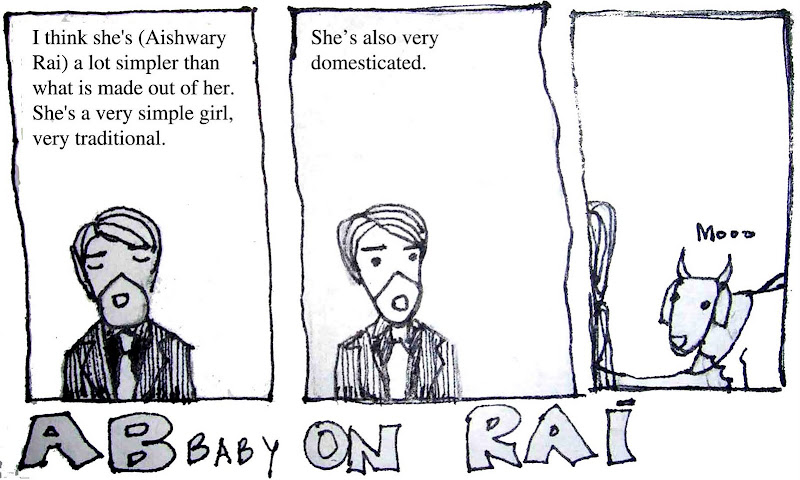
Domestication : the AB way and the Laljose way

AB baby on Rai: Cartoon by Chitra in Horticulture

"Now that theyre getting married, I am looking for new sources on the tv for comic strips. but maybe with amitabh making such bloopers I wont have to after all.."

[Cartoon strip by Chitra Venkataramany on Horticulture].

This domestication business does not begin with an Amitabh or does not end with an Aishwarya. Both in real life and in the reel-life. Take any of those so-called "strong" woman characters in our films, they are almost always sure to get domesticated. It is just a matter of finding the "right" man. (Chandni Bar recently in Hindi, films in which Manju Warrier played the tough woman in Malayalam.. Phir Milenge didn't attempt a romance between Shilpa and her Advocate saviour Abhishek, but the audience didn't seem quite happy that way).

The recent Malayalam hit Classmates took it one step further. Ok -- it had a proactive woman character (Suhra), something that we have hardly seen after the Manju Warrier days in mainstream Malayalam. The film didn't play safe with the 50+ heroes (Malayalam film viewers are supposed to dislike younger/newer heroes). It had a nonconventional storyline -- a thriller packed in some campus nostalgia. And an attempt at nonlinear story telling -- a commercially successful attempt, unlike Yuva/Ayudha Ezhuthu.

I was (like many others) happy the film became a runaway hit. Until I got to watch it in December, nearly four months after its release.

I was disappointed. It was still "better than the lot" as one my friend had opined, but a "better than the lot" film has more responsibility with it. Instead of taking that extra responsibility, Classmates just stretched our old prejudices, played out same old caricatures of "Muslim girl" and "Muslim girl's father", voyeured on the female body (it even had a re-run of boy-getting-into-girl's-bedroom-while-girl's-sleeping (supposedly heroic) scene lifted from the director's earlier film Meesamadhavan) and fed the male egoes.. What should have been a milestone that marked the new Malayalam cinema, stopped short of it.

What I found the most interesting was the way Suhra gets domesticated. It wasn't an easy task, as her man is dead. But Laljose does not give up. So it is the guy's parents who decide to "keep her" (the Bahu) and "take care of her". Shubham! What happier an end can one hope for?

Tuesday, November 21, 2006

Uchchakkum Rathriyum Kaaryam Kashtam

My friend has come to India after a training abroad. It seems he has got some Johnnie Walker with him. That takes care of the mornings but what about afternoons and evenings?

[reference: Malayalam film Udayanaanu Thaaram]

Friday, November 17, 2006

A Natural Question

This Onam, one of the leading periodicals in Malayalam published an interview with an author who writes short stories and has written a couple of novels. The last question was paticularly interesting: "When you write so much about intimate encounters between men and women, the natural question is whether it has anything to do with your experiences".

I don't understand why is this a "natural" question, and wonder if this would have been a "natural question" had the author been a man.

She could have just said that none of your business. But being a woman, and having to live in Kerala among an apparently intellectual society that is sex-starved and moralistic when it comes to women (many woman writers have faced threatening phonecalls and other kinds of threats), she prefers to give the safest answer possible-- a disclaimer that it's got nothing to do with her or anyone else's experiences, and they are completely imaginary.

* * *

I hear that Sithara S, who has written some quality short stories in Malayalam, has gone into silence. She didn't live in Kerala (probably out of the same fear) and was settled in a foreign country. But a woman has to keep fighting those who try to silence her-- either from the society outside or from within the family-- especially if she chooses to express (through writing, theatre.. whatever). I hope Sithara gets back into business soon-- the Malayalam short story scene is really sad.

Wednesday, November 08, 2006

Nicaraguayil Ortega!


Malloo film buffs may remember this dialogue from the film Sandesam: "..Nicaragua-yil Ortegaye purathakki avide oru pava government-ine sthapichu.." (In Nicaragua, Ortega was ousted and a dummy government was put in power.. [by the US])

Sreenivasan's character, a hardcore communist, tells this (and some comments on what happened in Polland-- it was a good laugh) in reply to his brother's-- he's a Congressman-- comments criticizing the left parties in Kerala. Their father, played by Thilakan, can't stand these two political rivals fighting in the house.

Today I was reminded of this line by my [needless to say, leftist] friend Dileep. It seems Ortega is coming back to power in the central American country after 16 years. He also sent me a link to Deshabhimani online news (CPI-M paper in Malayalam) that celebrates the comeback.

But another friend Arun tells us it's not the Ortega that he used to be.. It seems there are considerable changes his positions.

"Mr. Ortega, ousted in a 1990 election after his Sandinista government had fought a civil war against U.S.-backed Contra guerrillas, has reinvented himself as a moderate and a reconciler who will bring jobs and growth. His campaign colour is pastel pink, his rallies play John Lennon's Give Peace a Chance, and his running mate is Jaime Morales, an ex-Contra.

Mr. Ortega, 60, is paunchier since his rebel heyday, when he was compared to Che Guevara. Secularism has given way to support for the Catholic Church and its abortion ban campaign. He has declined to debate with rival candidates and focusses on rapturous rallies in the barrios.."

[ Sandinista comeback alarms U.S., also from The Hindu.)

However, if even a moderate, paunchy, Catholic Ortega is sending panic signals to the U.S., we may see more sanctions, more poverty (Nicaragua is apparently the second poorest country in the western half of the globe, after Hayti), another "axis of evil" and probably another war or another coup. It seems the U.S. had warned the people even before the elections of sanctions and other "dire consequences" that a Sandinista comeback would lead to. Business as usual.

Monday, October 30, 2006

Srividya, you'll be remembered


Actress Srividya died of cancer a few days back. When I think of Srividya the image that comes to me first is the Alice of Aadaminte Variyellu. Then there were many mother roles we can't forget-- Swati Tirunal, Apoorva Sahodarangal, Dalapati, Ente Sooryaputhrikku.. And there was Maggie of Daivatthinte Vikruthikal, for which she won the best actress award for the third time (Idavazhiyile Poocha Mindapoocha and Rachana were the first two, which I have not seen).

Deshabhimani pays tribute to the actress in its cinema page-- "Ananjupoyenkilum" by poet Rose Mary, followed by lyricist-director Sreekumaran Thampi recollecting his memories. Articles are in Malayalam, the link points to a pdf file so that there are no font issues.

[Here are links to The Hindu and Rediff takes].

Monday, August 21, 2006

Moonnamathoral and Bhargavacharitham Moonnam Khandam: Good work

Moonnamathoral poster

In general the Malayalam movie posters are going from bad to worse-- is it that the producers find it a waste spending money on good-looking posters or even having attractive fonts for the title? Most of the posters don't call for a second look, and the designers are at best finding some new words like "monsoon hit" "elephant hit" and "muttan megahit", but some recent designs by rahmandesign are exceptions. Especially "Moonnamathoral" and "Bhargavacharitham Moonnam Khandam" posters.

[Somewhat off-topic: While talking about Malayalam film industry's unwillingness to experiement, I missed mentioning V K Prakash who dared to make different films like "Mullavalliyum Thenmavum", "Police" and now "Moonnamathoral". "Mullavalliyum Thenmavum" and "Police" weren't big hits, but they stayed in the mainstream commercial league, as does "Moonnamathoral". I didn't get to see the earlier films, I think I should catch this one. Link: film site]

Chokher Bali: Uncontrollable feelings of a widow

Now, how would that title look on a poster? With some sleaze pictures of Aishwarya? If that is not enough, add this: "First glamour film of Aishwarya".

Rituparna Ghosh has given his consent or not, the Malayalam posters of the Tamil dubbed version of "Chokher Bali" reads "Perazhaki: Uncontrollable feelings of a widow". Some posters even claim that this film was banned in Northern India, while some others ask, "why was this beauty denied to the North Indian audience"? I am not aware of such a ban, I saw Chokher Bali about two years back in Bombay, and I know people who saw it in Rajasthan around the same time. Is it that anything goes when it comes to advertising?

The Tamil name of the film was "Aishwarya Rai oru Perazhagi", and that adopted similar marketing techniques in T.N., though the "banned in North India" thing wasn't there. Another difference is that in Kerala the film is running in A class centres (in Thrissur it is playing at the State Film Development Corporation-owned Sree) whereas it was mostly at B or C centres in Chennai.

[ Aishwarya Rai oru Perazhagi: 1 2 3 ]

Friday, August 11, 2006

Thiruttu Payale


Thiruttu Payale was the first movie I watched in Chennai. It had all the ingredients of a Masala potboiler and yet it was fresh and different. With enough twists and turns to keep your interest intact. I'd even call it a sensitive film though I think the gore was on the higher side.

It made me wonder why Malayalam film industry prefers remaining so stale. In terms of themes as well as presentation (and even actors). Even in Hindi mainstream there are experiments happening, even if most of it is inspired by some Hollywood films. We've seen it in some of the FACTORY products, and more recently in films like Munnabhai MBBS, Bluffmaster, Taxi No 9211, Omkara and Anthony Kaun Hai.

We (Malayalees) talk high about our intellectual supremacy and often make fun of Tamil moviegoers that they can't accept Rajni dying in a film. So what-- the Tamils have not got stuck on a Rajni or a Kamal. New heroes keep making their presence felt, and many of them actually go beyond being a one film wonder. And you know what, at least some of these films even have women characters who have a character. (RGV deserves special mention in this category. I think one of the weakest points in an otherwise interesting Bluffmaster was Priyanka's character). Thiruttu Payale in particular has two striking female leads.

Whereas Malayalam cinema appears to be stuck on same old stories, same old narratives.. Only expections I can think of (among recent mainstream films) are Udayananu Thaaram and Rajamanikyam, and to a much lesser extent Thanmathra. Even those films fell back on the same ancient heroes. Is there any reason for hope? I'm eagerly awaiting Rosshan's Notebook.

Friday, August 04, 2006

Akale Snehathil Ninnum

My friend sends me this..

All You who Sleep Tonight
by Vikram seth

All you who sleep tonight
Far from the ones you love,
No hand to left or right
And emptiness above -

Know that you aren't alone
The whole world shares your tears,
Some for two nights or one,
And some for all their years.

-Version in Malayalam-

akale snehathil ninnum
ethra ethra akaleyanu ningal.
arikukalil thangukalillathe,
mukalil anantha soonyatha.

ekammallennu mathram
ariyuka. lokam muzhuvan
ee kanneril cherunnu-
chilar onno rando
dinasandhyakal mathram.
mattu chilar kanneerinte
varshangalil eppozhum ennekkum.