Tuesday, February 20, 2007

Mahendra Singh Dhoni: Low class cricketer

Mahendra

Dhoni-dom is not quite the stardom that we are used to in Indian cricket.

I am not refering only to the guy's cricketing skills here. MSD is a class apart, literally. He belongs to the lower class.

You'd know what I mean if you've seen the ads that feature him.

We have seen stars drink Pepsi or Coke (or Boost!), ride Santro, wear Mayur or Siyaram suitings, show off their Rbk (and RSS, of late), be part of the Samsung team, eat Chyavanprash.. Whereas Dhoni's larger-than-life figure is all over in the interiors of the country in billboards that target the labour and farmer class.

So unlike our "master"s, "Maharaja"s and "Wall"s, Dhoni comes out as the "common man" of Indian cricket.

(One does not forget an under-19 captain who brought home the world cup and later became part of the senior team, he had the common man appeal in him but he never became a sellable star on his own. Sehvag was another person who came close).

Coming from Bihar Ranji team (and later Jharkhand), MSD has a way of his own. In everything. (Ever heard of anyone from a Bihar team making it to the Indian team before?) And with his game, he makes sure he can't be ignored by anyone for long.

The Telegraph carries an opinion page article on Feb 15:

"What stood out from the beginning was Dhoni's confident poise, the fact that he played from the start like an adult.. Dhoni never looked the young debutant, he never seemed tentative. He seemed to know what his business was and went about it with a calm self-possession that contrasted nicely with the violence of his methods.."

The article tries to find the reason:

"This might have had something to do with his apprenticeship in first-class cricket, which was a relatively long one. He had played five years of first-class cricket when he was selected to represent India.."

One of the earliest articles I could find on the man says: "I am sure M.S.Dhoni would get his turn to play for India and if he can produce atleast 60% of what he had played against Pakistan A and Kenya, then my word is that this guy would be a resounding success in the near future.."

He lived up to those words. In style.

In a game that is dominated by the "whites" of this country.

Coming back to the Telegraph article, that calls him "part Bheem, part Ekalavya":

"Indian teams are organized around codes of deference: "junior" players behave a certain way around "senior" players.. Dhoni, like Sehwag, doesn't fit into that mould.."

Let us hope he stays -- as a dependable player, as a star, and as a common man.

Thursday, February 15, 2007

Rain: Most unromantic

My friends are sleeping on a pavement. The water levels have risen, and it has become impossible to stay there any longer. I ask them where would they go, but there isn't much choice before them. All other pavements are already taken by someone or the other. The situation is not much better for them either, as the levels continue to raise. There's one tea-shop below ground level, and it becomes a pond when it rains. It is one of those smaller towns, probably somewhere in Kerala. Two little friends of mine, a boy and a girl, try to move to the nearby town. But by then, that town has become part of the first, as the city grows..


[It was raining last evening. It was also quite cold. I had an umbrella but my pants got wet. It wasn't so good a feeling. There have been times when I enjoyed getting wet (and rain was so romantic) but it wasn't like that yesterday. I shivered, my knees pained, the wetness itched. I changed to dry clothes as soon as I got home. I felt relieved. In the night, the blanket fell off my head for a while. It took so much for me to have a dream like that.]

Waking up from that dream took me to the Mumbai of 2005. The deadly rains. And that July 26. About four lakh people on the streets, their homes struck down by the authorities earlier that year. The Shanghai dream..

[NUMBER OF homes damaged by the tsunami in Nagapattinam: 30,300. Number of homes destroyed by the Congress-NCP Government in Mumbai: 84,000.

How agonised we are about how people die. How untroubled we are by how they live..

Some of us had read that one by Sainath. But even those who read it could not quite connect to what it would have been like for them during the rains. For many, it was about taxpayers' money, illegal occupation, stealing resources and cleaning up Mumbai.

We hardly cared to find out why so many people still keep migrating to our cities despite them being so unclean -- especially the areas they have to live in. And how bad their lives could be back in their villages. Not only in terms of being able to make a living -- also in terms of access to medical help, access to education for the children..]

..Some of my friends going door-to-door to collect relief. Disappointment on their faces, as they make many rounds and fail to get the message across.

The words are so powerless a means of communication!

[Wrting all this reminds me of another article titled "My Monsoons" that I read a few years back].

Sunday, February 11, 2007

Love in (and after) the time of Innocence

I remember one my friend telling about the love of his early college days, when he was sixteen or seventeen. Passionately in love with a girl in his class (and unable to convey his feelings) he would sing "Main duniyaa bhulaa dungaa.. / Teri chaahat mein.." (Aashiqui was hot then.)

When the girl started seeing someone else, the track changed to "Ab tere bin / Jee lenge hum.. / Zeher zindagii ka / Pee lenge hum.."

* * *

I'm sure most of you would agree it is diffucult to love like we do at that age -- as we become, well, mature. (We are becoming marichor -- the dead, not mature, as another friend puts it).

It does make sense to me when someone says she is not immature enough to love, nor mature enough for it. So is the case with me, as with many others.

We can not hope to go back to the innocence, or rather naiveness, of our pre-degree days. Yet we can not deny the role of those naive days in what becomes of us in the later years of life. We realize many of the assumptions on which we based what we called love were wrong. We grow up to a better understanding of the world and our own self. More often than not with a bitterness somewhere inside -- a fear of the other, fear of oneself. It does not matter whether you "won" the love or lost it.

So what is it to be able to love without fear?

I love these (oft-quoted) words of Gibran, and envy those who can love.


["Elevation of the self": painting by Gibran]

* * *

Picture ki heroine jhoot bol rahi hai
Kismat se tum humko mile hain
Andar ki andar woh bol rahi hogi
Sach to ye hai
Kismat se hum tumko mile hai

[Thanks to Manaswini who once goofed the lyrics]

Pyaar ke Side/Effects

A friend, who used to spend virtually all day and all night actively on the web, says he does not check mail often now, and if he gets a spare hour, he'd rather sleep it.

That was a pleasant surprise.

There's reason to believe it has something to do with the relationship he's in. Cheers to the woman who made the impossible possible.

Love does have its side effects.

Tuesday, February 06, 2007

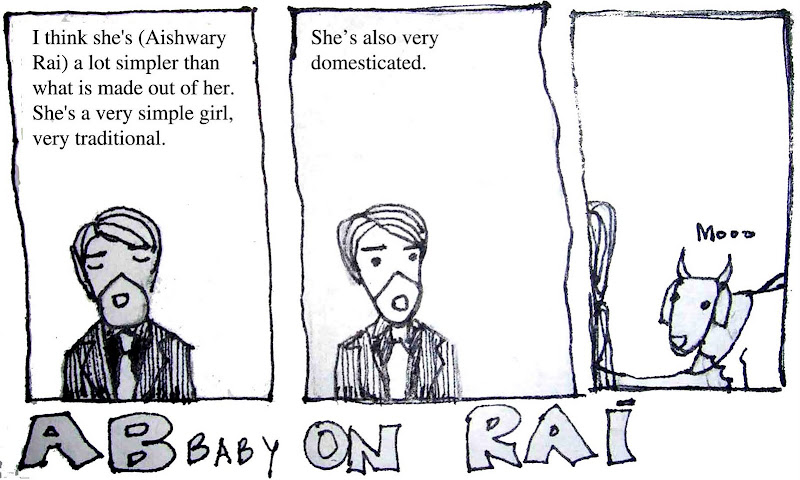
Domestication : the AB way and the Laljose way

AB baby on Rai: Cartoon by Chitra in Horticulture

"Now that theyre getting married, I am looking for new sources on the tv for comic strips. but maybe with amitabh making such bloopers I wont have to after all.."

[Cartoon strip by Chitra Venkataramany on Horticulture].

This domestication business does not begin with an Amitabh or does not end with an Aishwarya. Both in real life and in the reel-life. Take any of those so-called "strong" woman characters in our films, they are almost always sure to get domesticated. It is just a matter of finding the "right" man. (Chandni Bar recently in Hindi, films in which Manju Warrier played the tough woman in Malayalam.. Phir Milenge didn't attempt a romance between Shilpa and her Advocate saviour Abhishek, but the audience didn't seem quite happy that way).

The recent Malayalam hit Classmates took it one step further. Ok -- it had a proactive woman character (Suhra), something that we have hardly seen after the Manju Warrier days in mainstream Malayalam. The film didn't play safe with the 50+ heroes (Malayalam film viewers are supposed to dislike younger/newer heroes). It had a nonconventional storyline -- a thriller packed in some campus nostalgia. And an attempt at nonlinear story telling -- a commercially successful attempt, unlike Yuva/Ayudha Ezhuthu.

I was (like many others) happy the film became a runaway hit. Until I got to watch it in December, nearly four months after its release.

I was disappointed. It was still "better than the lot" as one my friend had opined, but a "better than the lot" film has more responsibility with it. Instead of taking that extra responsibility, Classmates just stretched our old prejudices, played out same old caricatures of "Muslim girl" and "Muslim girl's father", voyeured on the female body (it even had a re-run of boy-getting-into-girl's-bedroom-while-girl's-sleeping (supposedly heroic) scene lifted from the director's earlier film Meesamadhavan) and fed the male egoes.. What should have been a milestone that marked the new Malayalam cinema, stopped short of it.

What I found the most interesting was the way Suhra gets domesticated. It wasn't an easy task, as her man is dead. But Laljose does not give up. So it is the guy's parents who decide to "keep her" (the Bahu) and "take care of her". Shubham! What happier an end can one hope for?

Saturday, February 03, 2007

Conflicts

"I am afraid of certain words like fear, crime and foolishness.

I'm fascinated by certain words like brave, cool and peace.

But sometimes to be peaceful you have to grasp what is within fear.

And to avoid foolishness you have to be criminal.

To keep a voice innate you will have to be fool before so many.

I'm undergoin tremendous change in my mental make up. Trying to be able to accommodate so many bitter terms and be unconditional. I dont know where the ways will lead me to. But to be static is no dream, no truth and no goal. So I take up the journey now, if you meet me agin with same health richness and sanity, lets smile.
"

["bitter world. better world." by Sree, Towards a Language of My own]

She was responding to a talk we listened to at a seminar on Peace we attended,
trying to answer her inner and outer conflicts in this context.

Someone said at the seminar: "Conflicts are not necessarily negative. Without conflicts, you are static. Dead." And he concluded his talk saying dialogues are the right way towards resolving conflicts, not negotiations.

I found that observation interesting. The dialogue he talks about is not just between the State and Militant outfits. The dialogue between people, finding common areas to work with..

As we had observed before in this diary, our identities are becoming more and more rigid, and we are talking less and less. "The other" is becoming our enemy.

Can we hope to get back to friendly dialogues? I'm not sure. We have done enough damage to such prospects already. As a nation, as people, as religions.. But I still believe that is the way to go if we are to move towards a more harmonic existence (I'm not talking about one without conflicts).

I will sign off with a link to an article by the above mentioned speaker: Another 9/11, Another Act of Terror [pdf file].

"In this essay, I intend to narrate a story of another September 11, a story from the margins. It is the story of an ‘attack on democracy’, carried out not by ‘terrorists’ on a ‘suicide mission’, or through a military coup, but by the state in what is called the world’s ‘largest democracy’, and through an instrument of state terror on a section of its own population.."